In this video has English subtitle.
Honda K series engine
The Honda K series engine is a four-cylinder four-stroke engine. The K series engines are equipped with DOHC valvetrains and use roller rockers to reduce friction. The engines use a coil-on-plug, distributorless ignition system with a coil for each spark plug. This system forgoes the use of a conventional distributor based ignition timing system in favor of a computer controlled one that allows the ECU to control ignition timings based on various sensor inputs. The cylinders have cast iron sleeves similar to the B-series engines, as opposed to the FRM cylinders found in the H-series.
Two versions of Honda's i-VTEC system can be found on K series engines; variable timing control (VTC) can be found on the intake cam of both versions. The VTEC system on engines like the K20A3 only operate on the intake cam; at low RPM only one intake valve is fully opened, the other opening just slightly to create a swirl effect in the combustion chamber for improved fuel atomization. At high RPM, both intake valves open fully to improve engine breathing. In engines such as the K20A2 found in the Acura RSX Type-S, the VTEC system operates on both the intake and exhaust valves, allowing both to benefit from multiple cam profiles.
more details about K20A engine
วันอาทิตย์ที่ 3 เมษายน พ.ศ. 2554

Motorsports in Russia by Dragtimesinfo club.
In this video has 4 modified cars as follows :
Nissan GT-R R35 (850HP).
Nissan GT-R R34 (900HP) with sequential transmission.
Chevrolet Corvette ZR1 (730HP).
Nissan GT-R R35 with HKS modify kit (570HP)
2012 Nissan GT-R
 |
2012 Nissan GT-R |
 |
2012 Nissan GT-R |
 |
2012 Nissan GT-R |
 |
2012 Nissan GT-R |
 |
2012 Nissan GT-R |
 |
2012 Nissan GT-R |
– Nissan’s Multi-Dimensional 530-Horsepower Supercar Makes North American Debut at Los Angeles Auto Show, Set to Go On Sale in Early 2011 –
Entering its fourth year of availability in the North American market, the 2012 Nissan GT-R has a new look, new colors, new wheel design and, most important to fans of pure power, more horsepower under the hood. In addition, a new “Black Edition”– with unique seats, interior colors and wheels – joins the GT-R Premium model. The latest iteration of Nissan’s legendary supercar makes its North American debut that the 2010 Los Angeles Auto Show and will be available at official “GT-R certified” Nissan dealers across the United States in early 2011.
The 2012 Nissan GT-R’s advanced VR38DETT 3.8-liter twin turbo V6 now produces 530 horsepower (versus the previous 485 horsepower) and 488 lb-ft of torque (versus the previous 434 lb-ft) – a result of modifying the boost pressure of the turbocharger, valve timing and air mixture ratio, and through reducing intake air resistance by enlarging the inlet pipe diameter. In addition, exhaust air resistance was reduced through use of an enlarged section of exhaust pipe.
GT-R’s already impressive aerodynamics have been improved for 2012 with downforce increased by about 10% and the coefficient of drag reduced to 0.26 (from 0.27). Stability is improved by enlarged fascia and grille openings, which also help reduce air resistance inside the engine compartment. The volume of air that passes through the radiator and cools the front brakes is also increased.
The newly refreshed front fascia features aggressive double rectifier fins and new integrated high intensity LED running lights. Additional plated parts are used for the headlight inner panels, enhancing the car’s strong visual presence.
The redesigned rear fascia features a lower center of gravity than the previous design, created by using asculpted lower section and extended length. Underfloor cooling performance is also enhanced and air resistance reduced by extending the rear diffuser.
In addition, cooling performance for the muffler is improved and rear downforce is increased by about 10% through use of a new rear fascia outlet and new vents on the lower rear fenders that help remove air from the rear wheel wells. Newly designed larger diameter tailpipe finishers are also adopted. Six exterior colors are available, including two new colors: Deep Blue Pearl and Jet Black. Other available colors are Solid Red, Gun Metallic, Pearl White and a limited production 4-stage metallic Super Silver.
GT-R’s newly designed, lighter weight and more rigid forged aluminum 20-inch wheels, once again manufactured by RAYS®, help improve suspension response. Knurling inside the wheels is modified to help keep the tires from slipping around the wheels under heavy acceleration or braking. The wheels also feature a new premium dark (near black) finish, which provides a high quality, high-performance look. The Black Edition features special black six-spoke RAYS® lightweight wheels in place of the Premium model’s 10-spoke design.
Inside, the revisions for 2012 include new carbon fiber trim and upgraded materials. The Black Edition adds custom red-trimmed Recaro® seats, red and black interior trim and a dark headliner.
“The Nissan GT-R continues to be a multi-dimensional performance machine that lives up to the concept of ‘the ultimate supercar that can be driven by anyone, anytime, anywhere,’” said Al Castignetti, vice president and general manager, Nissan Division, Nissan North America, Inc. “With the enhancements for 2012, including its 530-horsepower twin turbo V6 and revised styling, the GT-R legend continues to grow. We can’t wait for its arrival in Nissan showrooms, and on the streets, here in the U.S.”
Additional information on the 2012 Nissan GT-R, including on-sale date, will be available in the coming months.
2012 Lamborghini Aventador LP700-4


Lamborghini Aventador LP 700-4 – A new reference among super sports cars
• Innovative concept and phenomenal performance redefine the pinnacle of the super sports car segment • Entirely new technology package, unique and powerful functional design language • Innovative carbon-fiber monocoque • New twelve-cylinder engine with 515 kW / 700 hp • Super-fast shifting ISR (Independent Shifting Rods) transmission • Pushrod suspension • The very finest equipment and trim, extensive individualization
With the Aventador LP 700-4, Automobili Lamborghini is redefining the very pinnacle of the world super sports car market – brutal power, outstanding lightweight engineering and phenomenal handling precision are combined with peerless design and the very finest equipment to deliver an unparalleled driving experience. With the Aventador, Lamborghini is taking a big step into the future – and building on the glorious history of the brand with the next automotive legend. The first customers will take delivery of the new Lamborghini Aventador LP 700-4 in late summer 2011.
The technology package of the Lamborghini Aventador LP 700-4 is utterly unique. It is based on an innovative monocoque made from carbon-fiber that combines exceptional lightweight engineering with the highest levels of stiffness and safety. The new twelve-cylinder with 6.5 liters’ displacement and 515 kW / 700 hp brings together the ultimate in high-revving pleasure with astonishing low-end torque. Thanks to a dry weight of only 1,575 kilograms (3,472 lb), which is extremely low for this class of vehicle, the weight-to-power ratio stands at only 2.25 kilograms per hp (4.96 lb/hp). Even the fantastic 0-100 km/h (0-62 mph) acceleration figure of just 2.9 seconds and the top speed of 350 km/h (217 mph) do not fully describe the Aventador’s extreme performance. And yet, fuel consumption and CO2 emissions are down by around 20 percent compared with its predecessor, despite the considerable increase in power (+8%).
The ISR transmission is unique among road-going vehicles, guaranteeing the fastest shifting time (only 50 milliseconds) and a highly emotional shift feel, while the lightweight chassis with pushrod suspension delivers absolute handling precision and competition-level performance. The expressively-designed interior offers hi-tech features ranging from the TFT cockpit display with Drive Select Mode system. The Aventador will be built to the very highest quality standards in an all-new production facility in Sant’Agata Bolognese.
“With the Aventador LP 700-4, the future of the super sports car is now part of the present. Its exceptional package of innovative technologies is unique, its performance simply overwhelming,” says Stephan Winkelmann, President and CEO of Automobili Lamborghini. “The Aventador is a jump of two generations in terms of design and technology, it’s the result of an entirely new project, but at the same time it’s a direct and consistent continuation of Lamborghini’s brand values. It is extreme in its design and its performance, uncompromising in its standards and technology, and unmistakably Italian in its style and perfection. Overall, the dynamics and technical excellence of the Aventador LP 700-4 makes it unrivalled in the worldwide super sports car arena.”
Aventador: the name of one of the most courageous of all bulls
According to its tradition, Lamborghini’s new flagship bears the name of a bull – naturally, a particularly courageous specimen from the world of the Spanish Corrida. Aventador was the name of a bull that entered into battle in October 1993 at the Saragossa Arena, earning the “Trofeo de la Peña La Madroñera” for its outstanding courage.
A sculpture of extreme dynamics
For Lamborghini, design is always the beauty of aggressive power, the elegance of breathtaking dynamics. From the very first glance, the new Aventador is unmistakably a Lamborghini, clothed in the brand’s characteristic and distinctive design language – with its extremely powerful proportions, its exact lines and precise surfaces, and with taut muscularity in every one of its details. The designers in the Centro Stile Lamborghini have carefully developed this design language to give the Aventador a significant new edge. It is an avantgarde work of art, an incredibly dynamic sculpture, from the sharply honed front end through the extremely low roofline to the distinctive rear diffuser. Every line has a clear function, every form is dictated by its need for speed, yet the overall look is nothing less than spectacular and breathtaking.
The doors open upward – of course
Truly impressive proportions come from an overall length of 4,78 meters (188.19 in.) matched with an impressive width of 2,26 meters (88.98 in.) including the exterior mirrors, and further accentuated by an extremely low height of just 1.136 mm (44.72 in.). It goes without saying that both doors of the carbon-fiber monocoque open upward – a feature that was first introduced in the now legendary Countach and then used for subsequent V12 models such as Diablo and Murciélago. However, the Aventador also evokes its immediate predecessor the Murciélago – electronically managed air intakes open depending on the outdoor temperature and the need for cooling air,ensuring maximum aerodynamic efficiency. And for those whishing to flaunt the heart of their Lamborghini, the optional transparent engine bonnet exhibits the twelve-cylinder engine like a technical work of art in a display case. Exclusive and high-tech interior
The Aventador’s spacious interior combines the fine exclusivity of premium materials and perfect Italian craftsmanship with state-of-the-art technology and generous equipment. The red switch cover on the broad center tunnel encloses the start button used to awaken the twelve-cylinder. The interior is dominated by a next-generation dashboard – as in a modern airplane, the instruments are presented on a TFT-LCD screen using innovative display concepts. A second screen is dedicated to the standard-fit multimedia and navigation system.
Carbon-fiber monocoque
The new Lamborghini flagship has a full monocoque. The entire occupant cell, with tub and roof, is one single physical component. This ensures extreme rigidity and thus outstanding driving precision, as well as an extremely high level of passive safety for the driver and his passenger. The entire monocoque weighs only 147.5 kilograms (325.18 lb).
The monocoque, together with the front and rear Aluminium frames, features an impressive combination of extreme torsional stiffness of 35,000 Newton meters per degree and weighs only 229.5 kilograms (505.9 lb).
Maximum revs, amazing sound
For the Aventador LP 700-4, the engineers in Lamborghini’s R&D Department have developed a completely new high-performance power unit – an extremely powerful and high-revving, but very compact power unit. At 235 kilograms (518 lb), it is also extremely lightweight. A V12 with 515 kW (700 hp) at 8,250 rpm sets a whole new benchmark, even in the world of super sports cars. The maximum torque output is 690 Newton meters (509 lb-ft) at 5,500 rpm. The extremely well-rounded torque curve, the bull-like pulling power in every situation, the spontaneous responsiveness and, last but not least, the finely modulated but always highly emotional acoustics are what make this engine a stunning power plant of the very highest order.
Innovative transmission for maximum performance
Engineers at Lamborghini have created the perfect mate for the new twelve-cylinder engine with the highly innovative ISR (Independent Shifting Rods) transmission. The development objective was clearly formulated – to build not only the fastest robotized gearbox, but also to create the world’s most emotional gear shift. Compared with a dual-clutch transmission, not only is the ISR gearbox much lighter, it also has smaller dimensions than a conventional manual unit – both key elements in the field of lightweight engineering for super sports cars.
Refined and safe with all-wheel drive
This kind of extreme power must be delivered reliably to the road. The driver of the Aventador LP 700-4 can depend fully on its permanent all-wheel drive – indicated by the 4 in the model designation. In the driveline, an electronically controlled Haldex coupling distributes the forces between front and rear. In a matter of milliseconds, this coupling adapts the force distribution to match the dynamic situation. A self-blocking rear differential together with a front differential electronically controlled by ESP make for even more dynamic handling. The Drive Select Mode System enables the driver to choose vehicle characteristics (engine, transmission, differential, steering and dynamic control) from three settings – Strada (road), Sport and Corsa (track) – to suit his individual preferences. Pushrod suspension
Lamborghini has equipped its new V12 super sports car with an innovative and highly sophisticated suspension concept. The pushrod spring and damper concept was inspired by Formula 1 and tuned perfectly to meet the needs of a high-performance road-going vehicle. Together with aluminum double wishbone suspension and a carbon-fiber ceramic brake system, this lightweight chassis represents a further aspect of the new flagship’s unique technology concept.
Extensive assistance and safety systems
In the hands of its driver, the Lamborghini Aventador LP 700-4 is a high-precision machine – spontaneous, direct and always reliable. The driver is also assisted by the latest electronic systems such as the incredibly sporty, adjustable ESP system. When it comes to passive safety, front, head-thorax and knee airbags play their part alongside the extremely stiff carbon-fiber cell.
A rich and wide-ranging individualization program
A Lamborghini should always fit perfectly with the style and preferences of its owner. To this end, the range of individualization options is virtually inexhaustible. There is a selection of 13 production paint colors to choose from, three of which are highly sophisticated matt tones. A choice of two-tone interiors are offered with the “Sportivo” and “Elegante” versions, while a premium audio system and reversing camera are among the many technology options. And of course, the “Ad Personam” individualization program knows no limits when it comes to colors and materials.
The price of the Lamborghini Aventador and market delivery UK: GBP 201.900,00 (suggested retail price taxes excluded) Europe: € 255.000 (suggested retail price taxes excluded) USA: 379.700 USD (suggested retail price – GGT included) China: RMB 6.270.000,00 (suggested retail price taxes included) Japan: YEN 39.690.000,00 (suggested retail price taxes included)
The first customers will take delivery of the new Lamborghini Aventador LP 700-4 in late summer 2011.
วันพฤหัสบดีที่ 31 มีนาคม พ.ศ. 2554
1970 TOYOTA Celica TA22
1970 advertisement of celica 1st gen.
First generation / A20/35 Series (1970–1977)
 | |
| Production | Dec 1970–Jul 1977[1] |
|---|---|
| Assembly | Toyota, Japan |
| Body style | 3-door liftback 2-door hardtop |
| Layout | FR layout |
| Platform | A20/35 |
| Engine | 1.4 L T I4 1.6 L 2T I4 1.9 L 8R I4 2.0 L 18R I4 2.2 L 20R I4 |
| Transmission | 4-speed W40 manual 5-speed W50 manual 3-speed A40 automatic |
| Wheelbase | 94.75 in (2,407 mm)[2] |
| Length | 164.2 in (4,170 mm) |
| Width | 63.0 in (1,600 mm) |
| Height | 53 in (1,300 mm)[2] |
| Curb weight | 890 kg (1,962 lb) (Early Coupe) - 1,166 kg (2,571 lb) (US Liftback) |
| Related | Toyota Carina Toyota Corona |
Displayed at the 1970 Tokyo Motor Show in October, and marketed in December of the same year, the Celica was a personal car that emphasized styling and driving enjoyment. Japanese models were ET, LT, ST, GT, and GTV. The appearance of the headlights recessed into the grille and the tail light treatment on the hatchback seem to suggest the appearance was influenced by the 1969–1970 Ford Mustang but on a much smaller scale.
For export markets, the Celica was offered in three different levels of trim; LT, ST and GT. The lower-end LT was equipped with the single carbureted four-cylinder 2T engine displacing 1600 cc, while the ST came with a twin downdraft-carburetor 2T-B engine. The 2T-G that powered the high-end GT model was a DOHC 1600 cc engine equipped with twin Mikuni-Solex Carburetors.
At its introduction the Celica was only available as a pillarless hardtop notchback coupe. The SV-1 liftback was shown as a concept car at the 1971 Tokyo Motor Show. With slight modifications, this was introduced in Japan in April 1973 as the 2000 cc RA25 and 1600 cc TA27 liftbacks. It was then exported to Europe in RHD form as the 1600 cc liftback. After the October 1975 facelift, it was available in both RHD and LHD forms in other markets. The RV-1 wagon was also shown at the 1971 Tokyo Motor Show but it did not reach production.
The Japanese GT models had various differences from the ET, LT and ST including the hood flutes, power windows, air conditioning, and specific GT trim, but shared a few things with the ST - a full-length centre console and oil pressure/ammeter gauges whilst the LT had warning lights for these functions.
There was also the GTV version, which had the 2T-G engine, a slightly cut-down interior, and did not come standard with things like power windows, but they were optional. The GTV has firmer suspension.
The first generation Celicas can be further broken down into two distinctive models. The first of these was the original with slant nose (trapezoid-like shape front corner light). This is for Coupe model only, TA22, RA20, and RA21. These models were released from 1970 to 1975 and came equipped with the 2T, 2T-G 1.6 liter, or 18R 2.0 liter motor. They had a 95 inches (2,400 mm) wheelbase. The second series (98 in (2,500 mm) wheelbase) had a flat nose (square front corner light) and slightly longer wheelbase, and was known in Europe as the TA23. This facelift model appeared in Japan in 1974, but for export was the 1976 model year. The Japanese version had engines under 2.0 liter so as to conform to Japanese regulations concerning engine displacement size, thereby allowing buyers to avoid an additional tax for a larger engine.
The first Celica for North America, 1971 ST was powered by 1.9 liter 8R engine competing with the Datsun 510 and Mazda 808 . The 1972-1974 models have 2.0 liter 18R-C engines. For 1975-1977, the engine for the North American Celica is the 2.2 liter 20R. The Celica GT and LT models were introduced in the U.S. for the 1974 model year. The top-line GT included a 5-speed manual transmission, rocker panel GT stripes, and styled steel wheels with chrome trim rings. The LT was marketed as an economy model. Mid-1974 saw minor changes in the Celica's trim and badges. The automatic transmission became an option on North American ST and LT models starting in the 1973 model year. For 1975, the '74 body was used, but body-color plastic fascia and sturdier chrome and black rubber bumpers, replaced the chrome bumpers used in the earlier cars (in accordance with US Federal bumper laws).
1970 Nissan Skyline KPGC10 2000GT
1st generation (1969-1972)
| Production | 1969-1972 |
|---|---|
| Body style | 4-door sedan 2-door coupe |
| Layout | FR layout |
| Engine | 2.0L 160 horsepower (120 kW) S20 I6 |
| Transmission | 5-speed Manual |
| Designer | Shinichiro Sakurai |
A popular name for the PGC and KPGC10 Skyline GT-R was "Hakosuka," which is a combination of the Japanese word for box ("hako" or ハコ) and the pronounced abbreviation of skyline ("Suka" or スカ as in スカイライン or "sukairain").
A total of 1,945 PGC and KPGC10 Skyline GT-Rs were produced.
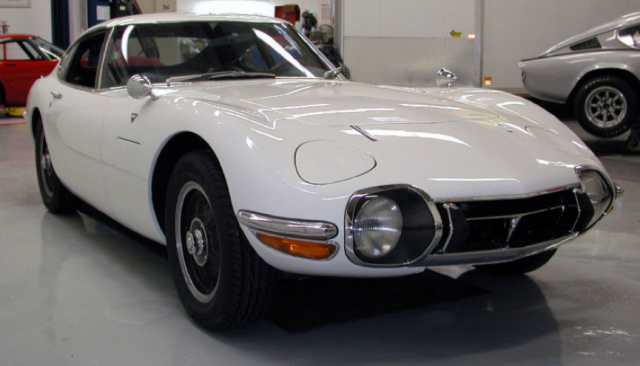
1967 Toyota 2000GT
สมัครสมาชิก:
บทความ (Atom)